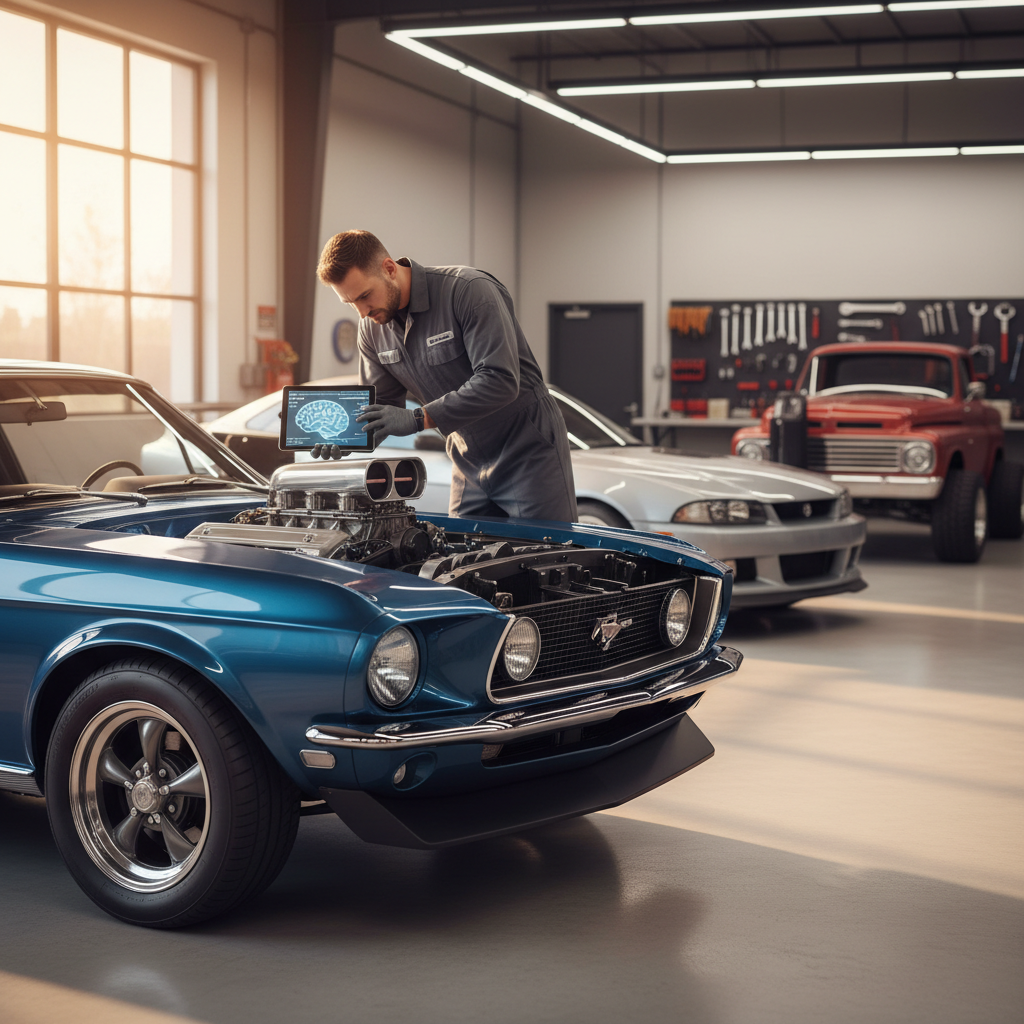
Most performance and custom shops miss the single biggest opportunity in AI search: their project cars. While your competitors are chasing broad keywords like "dyno tuning near me," you can attract a more passionate, high-spending customer by documenting and showcasing your best builds.
AI-powered search engines like Google's AI Overviews and Perplexity are not just looking for keywords. They are designed to answer complex questions and understand user intent. When a potential customer asks, "What's the best way to get 600hp from a 5.0 Coyote?" they don't want a generic service page. They want proof. Your project cars are that proof.
The "Project Car" Content Model
This strategy involves creating dedicated pages or detailed blog posts for each significant vehicle you build. Think of it as a case study for your shop's expertise. Instead of a simple gallery image, you create a comprehensive resource that details the entire journey of the vehicle. This is the exact kind of in-depth, expert content that AI search models are built to find and feature.
This content directly answers the unstated questions every potential customer has:
- Have you worked on my specific platform before?
- Do you understand my goals?
- Can you achieve the results I want?
- What parts do you recommend and why?
Answering these questions through detailed project showcases builds instant trust and positions your shop as an authority, not just another service provider.
Blueprint for a Perfect Project Page
Structure is key. A random assortment of photos and a paragraph of text won't work. AI search needs structured data it can easily parse and synthesize. Follow this blueprint for each project car page:
- The Goal: Start with the client's objective. Was it a specific horsepower target, a desired quarter-mile time, or a certain aesthetic?
- The Starting Point: Detail the vehicle as it arrived. Specify the year, make, model, and any existing modifications.
- The Parts List: This is crucial. List every single major component used in the build. For example: "Whipple Gen 5 3.0L Supercharger," "Kooks 1-7/8" Long-Tube Headers," "ID1050x Injectors." Don't just list them; link to the manufacturer or even your own service page for that part installation.
- The Process: Briefly describe the key stages of the build. You don't need to write a full installation manual, but walk the reader through the journey. "First, we established a baseline on the dyno. Next, we installed the full exhaust system before moving to the supercharger..."
- The Results: This is the payoff. Provide the final numbers, backed by proof. Include dyno sheets (with legible numbers), timeslips, and high-quality photos and videos. A video of the final dyno pull is one of the most powerful assets you can have.
By following this structure, you create a rich, detailed resource that answers dozens of potential search queries in one place.
How This Wins in AI Search
Let's consider a real-world example. A user asks an AI assistant, "Cost to supercharge a 2021 Mustang GT."
The AI doesn't just look for a page titled "Supercharger Installation." It synthesizes information from the most authoritative sources. It will find your project car page where you documented the installation of a Whipple supercharger on a 2021 Mustang. It sees your parts list, your description of the process, and the final dyno results.
Because your page is comprehensive, the AI can confidently extract this information to construct its answer. Your shop gets cited as the source, often with a direct link. You just intercepted a high-intent customer at the exact moment they were researching a high-value service. You didn't just rank for a keyword; you answered the user's entire question.
This strategy is far more effective than just having a "Tuning" or "Supercharger Installation" service page. Those pages are necessary, but they are generic. The project car page provides the specific, undeniable proof that AI search craves.
Putting It Into Action This Week
- Choose One Car: Pick one significant project your shop has completed in the last year. A car that represents the kind of work you want to attract more of.
- Gather Your Assets: Collect all the photos, videos, and dyno sheets associated with that build. You have them on your phone, your computer, and your dyno machine.
- Build One Page: Create a new page on your website. Use the car's description as the title (e.g., "750hp Whipple Supercharged 2021 Mustang GT Build").
- Follow the Blueprint: Write out the content following the Goal, Starting Point, Parts List, Process, and Results structure.
Once you build one, the next one becomes easier. Aim to add one new project page per month. Within a year, you will have built a powerful library of content that establishes your expertise and directly attracts customers looking for your specialized skills.
This isn't about creating more content; it's about creating the right content. The kind that proves your value long before a potential customer ever picks up the phone. At NextReach Solutions, we help performance shops translate their unique expertise into powerful digital marketing strategies that win in the new era of AI search. By focusing on what you do best—building incredible vehicles—you can create a web presence that works as hard as you do.
Want help putting these ideas to work for your shop? Request a call with NextReach Solutions.