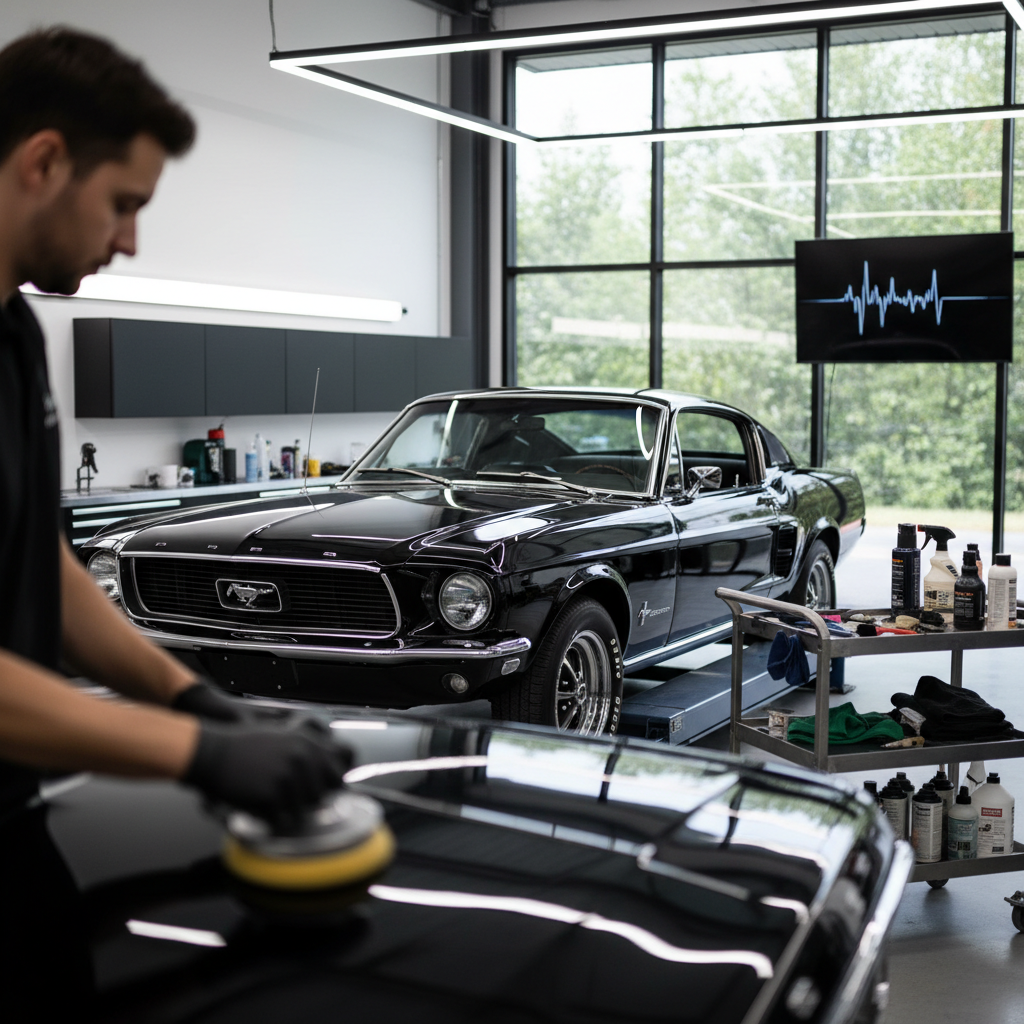
Your detailing website is clean. The photos are stunning, showcasing mirror-like finishes and impossibly clean interiors. But is it making you money? Or is it just an expensive online gallery?
For many detailers, the website is a passive portfolio. It proves you do good work, but it stops there. It leaves the most difficult job—choosing the right service—entirely up to the customer. When faced with a long list of options, a confused customer will do one of two things: leave, or default to the cheapest, most familiar option.
This is a critical failure of web design. Your website's primary job isn't just to show off your work; it's to sell your work. Specifically, it should be structured to guide a visitor from wanting a "good" service to desiring your "best," most profitable services, like paint correction and multi-year ceramic coatings. This requires a strategic approach to how you present your offerings.
The Psychology of Choice on a Detailing Website
If a potential customer lands on your site and sees a dozen different services—"Hand Wash," "Wash and Wax," "Clay & Seal," "One-Step Correction," "Level 2 Correction," "5-Year Ceramic Coating"—you're asking them to be an expert in your field. This is called choice paralysis. When presented with too many options without clear differentiation, people struggle to decide.
Your website needs to create a "value ladder." A customer needs to see a clear, logical progression from a good, entry-level service to a better, more involved one, and finally to the best, most comprehensive solution. The goal is to frame your premium packages not just as the most expensive, but as the most logical and valuable choice for a discerning customer.
Instead of making visitors assemble their own service from a menu of à la carte options, you need to guide them toward pre-built solutions that solve their problems.
Stop Listing Services, Start Presenting Solutions
The most common mistake on detailing websites is the "laundry list" service page. It’s a long, single-column list of every possible thing you can do to a car, with a price next to each. This format puts 100% of the cognitive load on the customer.
The solution is to bundle your services into three or four distinct, outcome-focused packages. This is the cornerstone of a high-converting website. By simplifying the choice, you clarify the value. Customers can now choose a path, not just a service.
Think in terms of "Good, Better, Best." For example:
- The Refresh (Good): Your premium interior/exterior detail. It’s the perfect entry point for a new customer and solves the immediate problem of a dirty car.
- The Restore (Better): This includes everything from the basic package plus a one-step paint correction and a high-quality sealant or wax. It solves a deeper problem: a dull, swirled finish.
- The Protect & Perfect (Best): Your signature offering. This is the full works: decontamination, multi-step paint correction, and a professional-grade, multi-year ceramic coating. It provides a long-term solution, not just a one-time fix.
This structure immediately reframes the conversation from "How much for a wash?" to "Which level of perfection am I looking for?"
Anatomy of a High-Converting Service Page
Once you have your packages defined, the design of the page is what makes them sell. The most effective layout, borrowed from the software industry, is the three-column pricing table. It allows for direct comparison and lets you visually emphasize your preferred option.
Here is how to structure it for maximum impact:
- Use a 3-Column Layout: Dedicate one column to each of your packages: "Refresh," "Restore," and "Protect & Perfect."
- Column 1 (Good): This is your entry-level package. Clearly list the primary features. The call-to-action button should be clear but standard, like "Book Your Detail."
- Column 2 (Better/Best): This is your target package—the one you want most customers to choose. It often represents the best blend of value and profitability. Make it stand out.
- Add a bold visual flag like "Most Popular" or "Best Value" above the package name.
- Use a higher-contrast, more compelling call-to-action button. Instead of just "Book Now," try "Book the Restore Package."
- Column 3 (Best/Ultimate): This is your highest-ticket service, like a 5- or 9-year ceramic coating. Its price serves to "anchor" the value of the other packages. The high price of the ultimate option makes your "Most Popular" package seem significantly more reasonable. The call-to-action here might even be different, such as "Request a Consultation," acknowledging the higher investment and consideration required.
This layout doesn't just present options; it guides the decision-making process, making your target package the most visually and psychologically appealing choice.
Building Perceived Value in Each Column
A three-column layout is only as good as the content within it. You must aggressively build the case for why "Better" and "Best" are worth the investment.
- Use Outcome-Oriented Checklists: Don’t just list what you do. List what the customer gets. Instead of just saying "5-Year Ceramic Coating," break down the benefits.
- ✓ Extreme gloss and relentless water beading for 5 years.
- ✓ Sacrificial layer to protect factory clear coat from environmental damage.
- ✓ Drastically simplifies future washing.
- ✓ Locks in the results of our paint correction.
- Answer Key Questions Proactively: For each package, explicitly state who it's for and what problem it solves.
- Who is this for? For the "Refresh" package: "Ideal for the daily driver needing a comprehensive reset." For the "Protect & Perfect" package: "For the enthusiast who wants the ultimate in gloss, protection, and ease of maintenance."
- How long does it last? Be specific. "Wex protection lasts up to 3 months." "Paint sealant provides protection for 6-8 months." "Coating durability is 5 years with annual maintenance."
- Leverage Price Anchoring: By placing your most expensive package in the lineup, you reframe the customer's perception of cost. A $900 paint correction and sealant package might seem expensive on its own. But when positioned next to a $2,500 multi-year ceramic coating package, it suddenly looks like a very reasonable and high-value option.
Supporting the Upsell Across Your Site
Your service package page is the main event, but it needs a supporting cast. The rest of your website must be built to reinforce the value of your high-ticket services.
- Dedicated Service Pages: While you present the packages on one page, your most valuable services (like ceramic coatings and paint protection film) deserve their own dedicated pages. The "Learn More" link in your "Protect & Perfect" package column should take users to a comprehensive page that explains the entire ceramic coating process, showcases the specific brands you use (and why), features videos of water beading, and has an extensive FAQ section. This is where you close the deal for the highly interested, high-investment customer.
- A Purpose-Driven Gallery: Don't let your gallery be a random dump of beautiful photos. Organize it by service. Allow users to filter your portfolio to see "Paint Correction Before & After," "Ceramic Coating Results," or "Interior Restoration." When a customer is considering your "Restore" package, you can show them exactly what a one-step correction from your shop looks like.
- Contextual Calls-to-Action (CTAs): Eliminate generic "Contact Us" buttons. Every CTA should be specific. On your ceramic coating page, the button should say, "Get a Ceramic Coating Quote." On your homepage banner featuring a glistening, coated car, the CTA should be "Explore Our Coating Packages." Guide the user on every single page.
By implementing this strategic structure, you transform your website from a static brochure into a 24/7 sales associate. You simplify the buying process for your customers, clearly articulate the value of your expertise, and systematically guide them toward your more profitable, higher-ticket services.
Building a website that actively sells requires a deep understanding of both web design and the specific goals of a detailing business. If you are ready to turn your website into a powerful tool for attracting and converting high-value customers, NextReach Solutions specializes in conversion-focused web design for automotive businesses like yours.
Want help putting these ideas to work for your shop? Request a call with NextReach Solutions.